
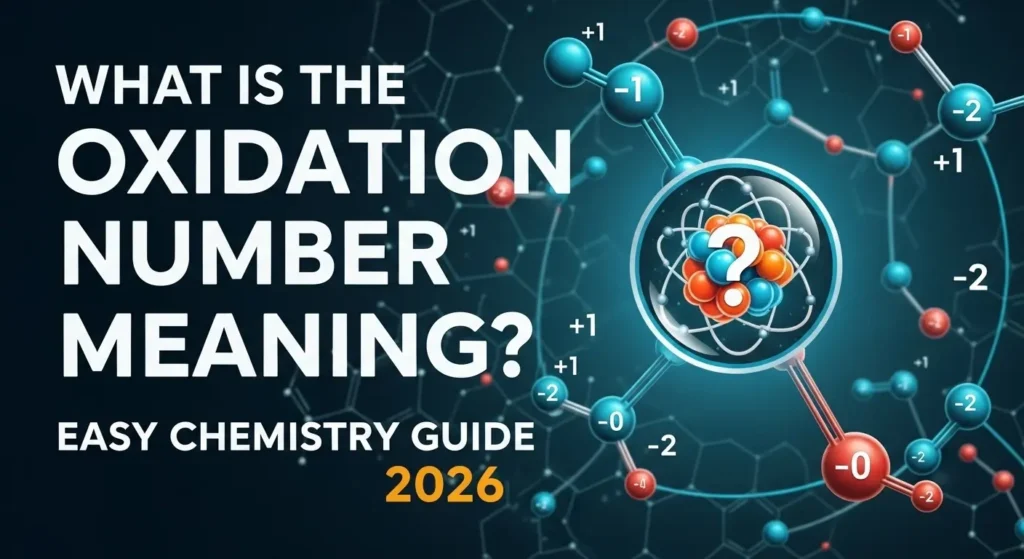
A number assigned to an element in chemical combination which represents the number of electrons lost (or gained, if the number is negative), by an atom of that element in the compound. The oxidation number meaning in chemistry refers to the assigned value that shows how many electrons an atom gains, loses, or shares during a chemical reaction. It helps determine the oxidation state of an element, making it easier to understand how substances interact and transform.
One quiet morning, Aamir sat in his classroom looking at a small chemistry experiment. The teacher placed a piece of metal in a liquid and explained how tiny particles were moving and changing. Numbers appeared on the board showing how atoms gain or lose electrons. At first it looked like just science, but Aamir felt curious.
“Nature speaks through patterns and numbers if we take time to understand them.”
How could such small changes explain the way materials transform? As he watched the reaction slowly happen, he realized something beautiful: change is part of nature’s design. Just like elements change during reactions, life also changes as we grow and learn.
“Every change in nature carries a lesson about growth and balance.”
The oxidation number meaning in chemistry explains how atoms gain or lose electrons during a reaction. It helps scientists understand how elements interact and change. But beyond science, the idea of balance and change can also inspire reflection about life. Just as atoms adjust their energy to stay stable, people also adjust their thoughts, actions, and choices to create harmony. Understanding the oxidation number’s meaning can therefore teach both scientific knowledge and a simple life lesson: growth often happens when change occurs in a balanced way.
What is the simple definition of oxidation number?
The oxidation number is a value that shows how many electrons an atom gains, loses, or shares in a chemical reaction. It helps us understand the charge behavior of atoms in compounds. In simple terms, it tells us the “electron status” of an element. It is useful in balancing chemical equations. This concept is mainly used in redox reactions. It helps identify how elements change during reactions. Oxidation numbers can be positive, negative, or zero.
Key Points:
- Shows electron transfer
- Used in chemical reactions
- Can be positive or negative
- Helps balance equations
- Important in redox chemistry
What is oxidation in simple words?
Oxidation is a chemical process in which a substance loses electrons. It often happens when oxygen is added or hydrogen is removed. In simple words, it means a change in the chemical state of an element. This process is always paired with reduction. Oxidation is a key part of energy production and corrosion. It helps explain how substances react and change. It is essential in chemistry and biological systems.
Key Points:
- Loss of electrons
- Often involves oxygen
- Happens in reactions
- Paired with reduction
- Found in nature
Why is it called oxidation number?
It is called oxidation number because it represents the degree of oxidation of an atom. The term comes from the process of oxidation, which involves electron loss. This number shows how oxidized or reduced an element is. It helps track electron movement in compounds. Scientists use it to understand chemical bonding. It is a standardized way to describe charge behavior. The name reflects its role in oxidation-reduction reactions.
Key Points:
- Based on oxidation process
- Shows electron status
- Indicates charge level
- Used in bonding analysis
- Helps in redox study
What does a high oxidation number mean?
A high oxidation number means the element has lost more electrons. It shows that the atom is in a more oxidized state. This usually happens in strong reactions. It indicates less electron availability. High oxidation numbers often appear in metals or transition elements. It helps identify reaction strength. It also shows chemical stability changes.
Key Points:
- More electron loss
- Highly oxidized state
- Indicates strong reaction
- Less electron availability
- Common in metals
Oxidation number meaning in chemistry
In chemistry, oxidation number meaning refers to the assigned charge of an atom in a compound. It helps track electron movement in reactions. This concept is essential in redox chemistry. It allows scientists to balance complex equations. It shows how atoms interact chemically. Oxidation numbers simplify reaction analysis. They are widely used in inorganic chemistry.
Key Points:
- Assigned atomic charge
- Tracks electrons
- Used in redox reactions
- Helps balance equations
- Important in chemistry
Oxidation number of elements from 1 to 30
The oxidation numbers of elements from 1 to 30 vary depending on their chemical properties. For example, hydrogen is usually +1, oxygen is -2, and alkali metals are +1. Transition metals can have multiple oxidation states. Each element behaves differently in reactions. These values help predict compound formation. They are based on periodic table trends. Understanding them is important for chemistry studies.
Key Points:
- Varies by element
- Hydrogen usually +1
- Oxygen usually -2
- Metals have multiple states
- Based on periodic trends
How to find oxidation number trick
To find oxidation numbers, you can use simple rules and patterns. Start by knowing common values like oxygen (-2) and hydrogen (+1). Then apply charge balance in compounds. The sum of oxidation numbers equals the total charge. Use periodic table trends for guidance. Practice makes it easier to identify quickly. This method helps solve chemistry problems faster.
Key Points:
- Use standard rules
- Oxygen is usually -2
- Hydrogen is +1
- Sum equals total charge
- Practice improves speed
Rules of oxidation number
Oxidation number rules help assign correct values to atoms. Free elements have oxidation number zero. Oxygen is usually -2 except in peroxides. Hydrogen is usually +1 except in metal hydrides. The total oxidation number equals compound charge. Metals usually have positive values. These rules are essential for solving reactions.
Key Points:
- Free elements = 0
- Oxygen usually -2
- Hydrogen usually +1
- Total equals charge
- Metals are positive
Oxidation number of hydrogen
Hydrogen usually has an oxidation number of +1 in most compounds. However, in metal hydrides, it becomes -1. It depends on the element it bonds with. Hydrogen plays an important role in acid-base chemistry. Its oxidation state helps identify reaction behavior. It is widely used in chemical equations. Understanding it is important in redox reactions.
Key Points:
- Usually +1
- Can be -1 in hydrides
- Depends on bonding
- Important in acids
- Used in redox
Oxidation number of ions
The oxidation number of ions is equal to their charge. For example, Na⁺ is +1 and Cl⁻ is -1. Polyatomic ions have combined oxidation values. These values help in balancing reactions. Ions play a key role in chemical bonding. Understanding their oxidation state is essential in chemistry. It simplifies reaction calculations.
Key Points:
- Equals ionic charge
- Example Na⁺ = +1
- Polyatomic ions vary
- Helps balance reactions
- Important in bonding
Oxidation number of metals
Metals usually have positive oxidation numbers because they lose electrons easily. Alkali metals are always +1, while alkaline earth metals are +2. Transition metals can have multiple oxidation states. Their oxidation numbers depend on compounds. Metals play a major role in redox reactions. They often act as reducing agents. Understanding them helps predict reactions.
Key Points:
- Usually positive
- Alkali metals +1
- Alkaline earth +2
- Variable states
- Act as reducing agents
Oxidation number meaning in periodic table
In the periodic table, oxidation number meaning refers to typical charge behavior of elements based on their groups. Elements in the same group often have similar oxidation states. This helps predict chemical reactions easily. Metals tend to have positive values, while non-metals have negative ones. It shows reactivity trends across periods and it is useful in understanding bonding patterns. It simplifies chemical predictions.
Key Points:
- Based on periodic trends
- Similar group behavior
- Metals positive, non-metals negative
- Helps predict reactions
- Shows reactivity patterns
Angel Number Oxidation Number – What Does It Mean?
The oxidation number describes the charge an atom appears to have when electrons are shared or transferred during a chemical reaction. It helps explain how elements combine and transform. In chemistry, oxidation numbers show whether an atom has gained or lost electrons.
These values help scientists predict reactions and understand chemical balance. In a symbolic sense, this idea also reflects balance and transformation. Just as atoms adjust their state to create stability, people adjust their lives to find purpose and harmony. The concept encourages us to:
- Understand change as a natural process
- Maintain balance in our actions and decisions
- Recognize that growth often follows transformation
As one meaningful thought reminds us,
“Balance is the quiet force that allows change to create something new.”
Oxidation Number Meaning in Different Contexts
Numbers and patterns are often used to explain both science and symbolic ideas. The oxidation number concept can be compared with other number interpretations that people reflect on.
| Number / Symbol | Common Meaning | Connection with Oxidation Number Meaning |
| 11 | Awareness and intuition | Recognizing patterns in systems |
| 111 | Alignment and focus | Balance between elements |
| 101 | New beginnings | Transformation and reaction |
| Oxidation number | Electron balance | Change and stability |
| This table shows how numbers help people understand both physical systems and deeper patterns. |
The Secret Meaning and Symbolism
The deeper oxidation number meaning symbolizes transformation, balance, and the way small changes create larger results. In chemistry, oxidation numbers track how electrons move between atoms. This movement allows reactions to happen. Without this exchange, many natural processes would not exist. In a symbolic way, this reminds us that life also changes through exchange and experience. Key symbolic lessons include:
- Transformation
- Change helps growth happen
- New results appear when energy shifts
- Change helps growth happen
- Balance
- Stability comes when forces remain balanced
- Harmony supports healthy systems
- Stability comes when forces remain balanced
- Connection
- Elements interact to create new substances
- People interact to create meaningful experiences
- Elements interact to create new substances
- Awareness
- Understanding systems helps us make better decisions
- Observation leads to learning
These lessons show how scientific ideas can also inspire thoughtful reflection about life.
- Understanding systems helps us make better decisions
Why Do You Keep Seeing Oxidation Numbers?
Seeing oxidation numbers usually happens in learning or science contexts, but noticing them can inspire curiosity about patterns and transformation. Sometimes students or learners notice certain numbers repeatedly while studying chemistry. This often happens when the mind becomes interested in understanding a concept deeply.
Spiritual Growth
Learning new ideas can open the mind to deeper understanding. Knowledge itself becomes a path to growth.
- Encourages curiosity
- Develops critical thinking
- Builds awareness of natural processes
New Chapter
Understanding complex ideas often marks a new stage of learning.
- Moving to advanced knowledge
- Exploring deeper scientific concepts
- Expanding personal understanding
Letting Go
Science teaches us to release wrong assumptions and learn from new evidence.
- Accept new knowledge
- Adapt thinking when needed
Achieving Dreams
Education and knowledge help people reach their goals.
- Strong learning habits
- Patience and focus
- Continuous improvement
Oxidation Number Meaning in Common Life Situations
Even though oxidation numbers belong to chemistry, the concept of balance and transformation appears in everyday life. People experience similar ideas when they:
- Adapt to new challenges
- Learn new skills
- Balance responsibilities
- Change habits to improve life
These moments show how growth often happens through adjustment and learning.
Oxidation Number Significance
The significance of oxidation numbers lies in understanding how elements change during chemical reactions. In a broader sense, it also highlights the importance of balance and interaction. This concept reminds us that progress often depends on cooperation and exchange.
Key ideas include:
- Systems stay stable through balance
- Change creates new possibilities
- Learning reveals hidden patterns in nature
The Shadow Side of Oxidation Number Meaning
Even useful systems can be misunderstood. Challenges may appear when:
- Students focus only on memorizing numbers without understanding concepts
- Complex rules feel confusing
- People lose curiosity about learning
The solution is simple: approach learning with patience and curiosity rather than pressure.
Oxidation Number Meaning and Spirituality
In a reflective sense, oxidation numbers can symbolize the balance of energy and transformation in nature. Nature constantly changes through reactions and exchanges. Observing these processes reminds us that growth also comes through transformation and balance.
Oxidation Number Meaning and Love
Symbolically, oxidation ideas can remind us that healthy relationships depend on balance and exchange. Relationships grow when people share energy, understanding, and support. Balance helps maintain harmony.
Oxidation Number Meaning and Twin Flame Meaning
In symbolic discussions, transformation plays a role in personal growth before deep connections form. This idea reflects how individuals learn, grow, and develop understanding before forming stronger bonds.
Oxidation Number Meaning and Numerology
Numerology studies patterns in numbers. While oxidation numbers belong to chemistry, their use still reflects important qualities:
- Order
- Logic
- Systematic thinking
- Clear understanding of patterns
These qualities help people develop strong analytical skills.
Oxidation Number Meaning and the Law of Attraction
The Law of Attraction teaches that focus and intention shape experiences. Learning complex ideas like oxidation numbers reminds us that focused attention leads to understanding and achievement.
Helpful practices include:
- Consistent study habits
- Positive thinking about learning
- Clear goals for education
Oxidation Number Meaning and Its Biblical Insight
Although oxidation numbers are scientific concepts, many teachings about wisdom encourage learning and understanding nature. Studying the natural world often brings appreciation for balance and design in creation.
Oxidation Number Meaning and Relationships
The concept of balance also appears in human relationships. Healthy connections often include:
- Mutual respect
- Shared effort
- Emotional balance
- Support during change
Just as atoms interact to create stable compounds, people interact to build strong relationships.
FAQs
What does oxidation number mean?
The oxidation number meaning refers to the charge an atom appears to have after losing or gaining electrons during a chemical reaction.
Why are oxidation numbers important?
They help scientists understand chemical reactions and predict how elements will combine.
Is oxidation number used in everyday life?
Yes, it is used in chemistry, environmental science, medicine, and many industrial processes.
Is oxidation number related to spirituality?
In science it is not spiritual, but the idea of balance and transformation can inspire thoughtful reflection about life.
Is the oxidation number difficult to understand?
With simple rules and practice, it becomes easier to understand and apply.
Conclusion
Science often reveals beautiful patterns that exist in nature. The oxidation number meaning may seem like a small concept from chemistry, yet it shows how elements interact, change, and create new forms. Through the movement of electrons, reactions happen, materials transform, and the natural world continues its constant cycle of change.
Understanding this idea helps us appreciate the hidden order behind everyday processes. When we look deeper, we see that balance plays a central role in both science and life. Atoms adjust their energy to maintain stability, and people also adjust their actions and thoughts to create harmony. Growth rarely happens without change.
“True understanding grows when curiosity meets patience.”
Just as oxidation reactions transform substances, experiences transform our understanding and character. Learning about concepts like oxidation numbers reminds us that knowledge itself is a journey. Every new idea expands our awareness and helps us see the world more clearly.
Curiosity becomes the key that opens doors to discovery and personal development. When we approach learning with patience and wonder, even complex ideas begin to make sense.
As you continue exploring science and life, remember that transformation is part of progress. Change, balance, and curiosity work together to shape both knowledge and experience.
Read More Expert Guides…..
- Wireless Number Meaning: Insights for Luck, Career and Love
- Work Phone Number Meaning and Professional Success
- Ext Phone Number Meaning in Daily Life – A Spiritual Sign

Theo Symbolis is a modern symbollism analyst with full-spectrum expertise across all number clusters. He works with angel numbers, relationship guidance, twin flame and soulmate symbolism, spiritual numerology, biblical number meanings, and technical interpretations involving phone numbers, IDs, and digital sequences. Theo’s style combines logical reasoning with symbolic depth, making his work especially relevant for today’s numerically driven world.